Hygraph and Contentful solve the same problem from two different starting points. One was built API-first around REST, then added GraphQL on top. The other was built GraphQL-native from day one, with content federation as the whole point. The real question: engineer the architecture yourself, or let the platform handle it? If your team is tired of workarounds for relational content, or your Contentful bill keeps climbing faster than your content model justifies, keep reading.
The core difference nobody talks about clearly.
Most comparisons get stuck on surface-level checklists, seats, storage limits, and integration counts, which are useful but miss the point.
Contentful is the category's oldest name, and it built its reputation on a clean, UI-first editorial experience and a REST API that predates GraphQL's mainstream adoption. GraphQL exists in Contentful today, but it's a layer added on top of a REST-native foundation, and it's read-only, so mutations still go through REST. For teams with simple, flat content models and a preference for a polished, familiar admin panel, that foundation has served them well for over a decade.
Hygraph starts from a different premise: GraphQL and content federation aren't features bolted on later; they're the architecture itself. Content doesn't just live in Hygraph; Hygraph becomes the layer that connects your CMS content with your product data, your legacy systems, and your third-party APIs, all through one unified GraphQL endpoint. Nothing migrates. Everything connects.
Neither approach is wrong on its own terms, but they lead to very different day-to-day realities for your team, your budget, and your roadmap, and that's the real decision.
What Contentful actually does and where it holds up
Contentful is built around a page-and-entry content model, with a UI that non-technical editors pick up quickly, especially teams coming from WordPress or Notion. Its REST API is mature and well-documented, GraphQL is available as an additional layer, and the integration ecosystem is broad, given how long the platform has been in the market.
Where Contentful earns its reputation is in enterprise editorial workflows: structured entry types, localization, and a UI that keeps content teams productive without pulling developers into every publishing decision. For flat, page-based content models without heavy relational complexity, that's a genuinely solid experience.
The trade-offs show up as you scale. Contentful's GraphQL layer is read-only, so any content mutation still routes through REST, which means teams don't get a consistent API story across read and write. Pricing climbs sharply past the entry tier, paid plans start well above other platforms in the category, and enterprise contracts can run into five figures annually. Larger, more relational content architectures also get operationally heavier on Contentful than the marketing suggests, and migrating away from it later is notoriously difficult because of its proprietary content model format.
What Hygraph actually does and why it matters at scale
Hygraph is a GraphQL-native headless CMS, not GraphQL as an add-on, but GraphQL from the ground up, with strongly typed schemas, no over-fetching, and one consistent API for both reads and writes. If your frontend stack is already GraphQL-first, Hygraph fits with no translation layer required.
The real differentiator is content federation. Hygraph pulls data from external REST APIs, GraphQL APIs, databases, and legacy systems directly into your content model without migrating anything. Your content stays where it already lives, and Hygraph becomes the connective layer across your entire stack, not a plugin, but how the platform is designed to work from the ground up.
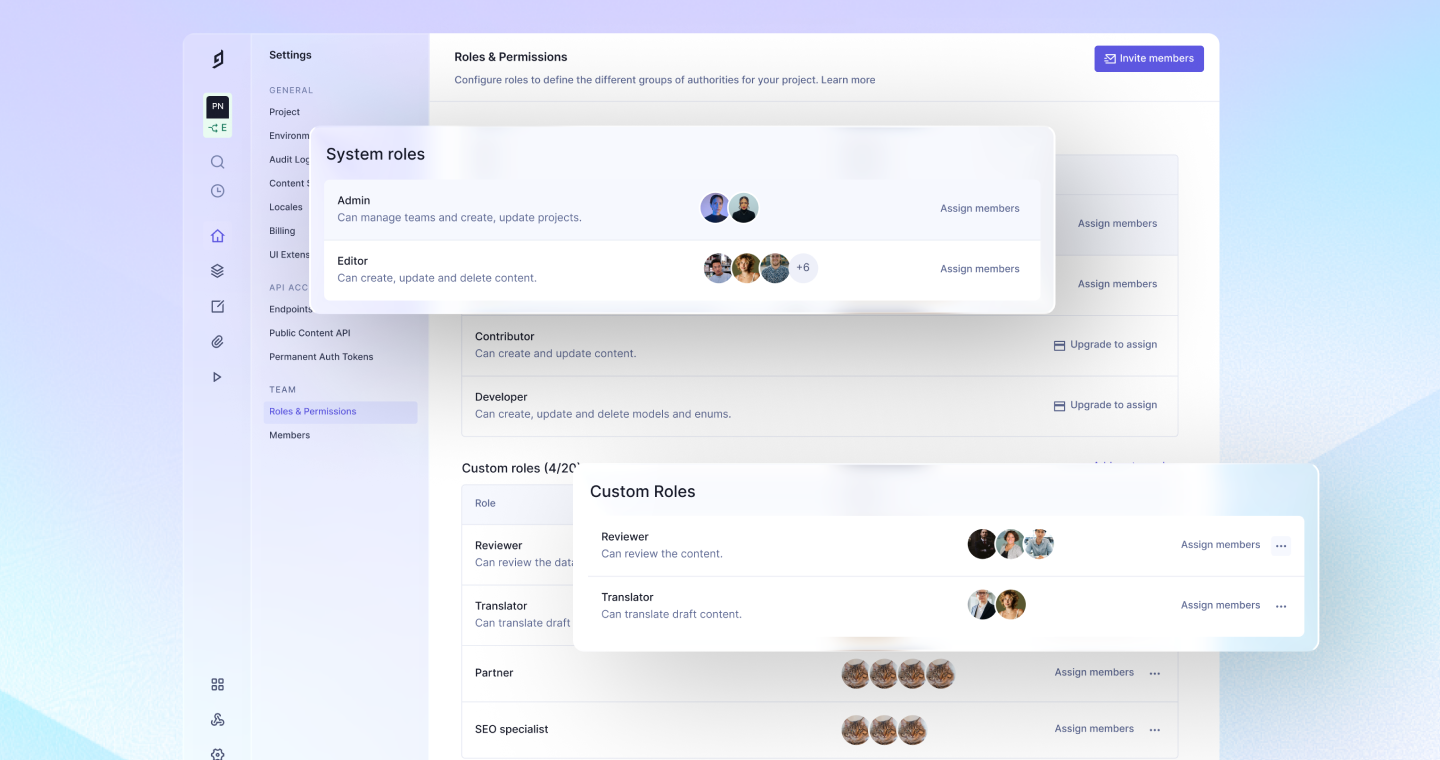
Beyond that, Hygraph ships with a visual, no-code schema builder so editors and product owners can model content without a developer in the loop, fine-grained role-based permissions, approval workflows, native multi-locale support, and a global CDN with advanced caching available on every plan, not gated behind a premium tier. Enterprise compliance, including SOC 2 Type 2, ISO 27001, and full GDPR, comes without custom security configuration.
Hygraph is also fully MACH-certified, which, for enterprise procurement teams, is a real signal of architectural maturity. And on pricing, Hygraph runs on a project-based model rather than Contentful's steep per-tier jumps, which is a large part of why teams that switch report significant cost reductions.
Where they split and the differences that actually matter
API architecture
Hygraph is GraphQL-native for both reads and writes, with schema generation and relational querying built directly into the platform. Contentful is REST-native with GraphQL layered on top, and that GraphQL layer is read-only.
Content federation
Hygraph has it built in with no extra setup, so you can query external data sources alongside your CMS content through one endpoint. Contentful doesn't offer this natively; everything you manage stays inside Contentful's own content model.
Content modeling
Hygraph is designed around relational content systems that treat content as reusable, connected components. Contentful supports modular content models, but larger relational architectures get operationally heavier as they grow.
Pricing
Hygraph runs on predictable, project-based pricing with a global CDN and advanced caching included on every plan. Contentful's paid plans start well above the category average, and advanced caching and features like Studio and Personalization sit behind premium, custom-quoted tiers.
Editorial and developer experience
Hygraph balances a structured, no-code editor UI with developer-native GraphQL control, so neither side has to compromise. Contentful's UI-first approach is genuinely strong for non-technical editors, but that focus has pulled the platform further from developer-level control over data structures and relationships.
Portability
Hygraph content connects to your existing systems without migration. Contentful uses a proprietary content model format, which is well known in the industry for making migration away from the platform difficult once you're in it.
Side-by-side comparison
Hygraph | Contentful | |
|---|---|---|
API Architecture | GraphQL-native for reads and writes | REST-native, with read-only GraphQL layered on top |
Content Federation | Built in. Unifies APIs, databases, and legacy systems into one endpoint | Not available natively |
Schema Builder | Visual no-code builder. No developer needed | UI-first entry types, strong for flat models |
Editor Experience | Clean UI. Non-technical teams can work independently from day one | Polished and familiar, especially for teams from WordPress or Notion |
Governance and Roles | Fine-grained permissions and approval workflows built in | Custom roles available, like advanced setups, often need premium tiers |
Caching and CDN | Global CDN and advanced caching are included on every plan | Advanced caching typically limited to premium tiers |
Compliance | SOC 2 Type 2, ISO 27001, and GDPR out of the box | GDPR-compliant, SOC 2 Type 2, ISO 27001 |
MACH Certified | Yes, fully certified | Not formally MACH-certified |
Pricing | Project-based. Predictable at scale | Tiered, with a steep jump into premium and custom enterprise pricing |
Migration Portability | Federated architecture, no lock-in on external data | Proprietary content model, migrating away is notoriously difficult |
Best Fit | Relational, multi-source, and federated content architectures at enterprise scale | Flat, page-based content models with dedicated editorial teams |
For Hygraph's own take on the matchup, they've published their comparison with Contentful as well. And if Sanity is also on your shortlist, our Hygraph vs Sanity breakdown covers that side of the decision.
Stop here and pick one.
Choose Hygraph if:
- You're managing content across multiple systems, APIs, or data sources, and need a single unified layer
- Your team includes non-technical editors who need to work without a developer for every update
- Your content model is genuinely relational: products, variants, regions, brands, not just a stack of flat pages
- Your stack is GraphQL-first, and you want one consistent API for reads and writes
- SOC 2, ISO 27001, or MACH certification is on your enterprise procurement checklist
- You want infrastructure costs that scale predictably, not a bill that jumps every time you touch a premium feature
Choose Contentful if:
- Your content is mostly flat, page-based entries without heavy relational complexity
- Your editorial team is large, non-technical, and already comfortable with Contentful's UI patterns
- You have existing investments in Contentful-specific workflows and integrations you're not ready to move off
- REST is your team's primary API pattern, and GraphQL is a nice-to-have, not a requirement.
The enterprise case for Hygraph
Picture this: five regional marketing teams updating the same product content in different languages, pulling from a legacy PIM and a product catalog, with a head of content who needs to approve everything before it goes live. On a REST-native setup with GraphQL bolted on, that's custom integrations for the federation layer, a governance system someone has to build by hand, and a localization workflow that only gets messier as new markets come online.
On Hygraph, that's the default architecture. Content federation handles the data sources, native localization handles the language variants, and role-based workflows handle the approvals. You're not building that infrastructure; you're configuring it.
For teams that started on Contentful and are now hitting the ceiling, more relational complexity than the content model wants to handle, a bill that's outpaced the value, a migration that keeps getting harder to justify putting off- Hygraph is the platform we point to, which is why it's increasingly the default recommendation in 2026 for teams evaluating a genuine Contentful alternative.
How we work with Hygraph at UPDOT
UPDOT is an official Hygraph partner, and we've built production systems on it, know the platform inside and out, and have direct access to the Hygraph team when our clients need it. So when we recommend Hygraph over Contentful, it comes from real implementation experience, not from reading feature comparisons.
For most projects that involve multi-source content, relational product or catalog data, or teams where non-technical editors need to work independently without ongoing developer dependency, Hygraph is our first recommendation, and for teams actively looking to move off Contentful, we handle the migration path as part of the build.
The conversation we have with every client before recommending anything is simple: what does your team actually look like, where does your data live, and how does your content infrastructure need to scale? The platform follows from that, not the other way around.
The short version
Contentful gives editorial teams a polished, familiar UI for flat, page-based content, and if that's genuinely all your content model needs, it still holds up. Hygraph gives teams a unified, relational content layer that works out of the box: federation, one consistent GraphQL API, governance, compliance, and predictable pricing, without having to build any of it yourself or pay premium-tier rates to unlock it.
For most of the teams we work with, especially the ones outgrowing a flat content model or the ones evaluating a real Contentful alternative for 2026, the answer is Hygraph, not because Contentful is wrong, but because the problem they're solving is exactly what Hygraph was built for.
Not sure which one fits what you're building?
We'll look at your actual stack, your team, and your content requirements and give you a straight answer. No pitch, no package, just clarity on the right call for your situation. Get in touch with us, and let's figure it out together.