
Legacy system modernization with AI is not a rip-and-replace project. It's a discipline problem dressed up as a technology problem, and most organizations get the sequence backwards.
They watch a vendor demo where a model rewrites a ten-year-old codebase in an afternoon, greenlight an "AI-accelerated modernization sprint," and six months in they're debugging AI-generated code nobody reviewed, running on infrastructure nobody mapped, connected to business logic nobody fully understood in the first place.
We think about legacy system modernization with AI the same way we think about every engineering decision at UPDOT: AI accelerates the work, but a human keeps a hand on the wheel. That's the difference between modernization that compounds and modernization that quietly creates the next generation of technical debt.
What Is Legacy System Modernization?
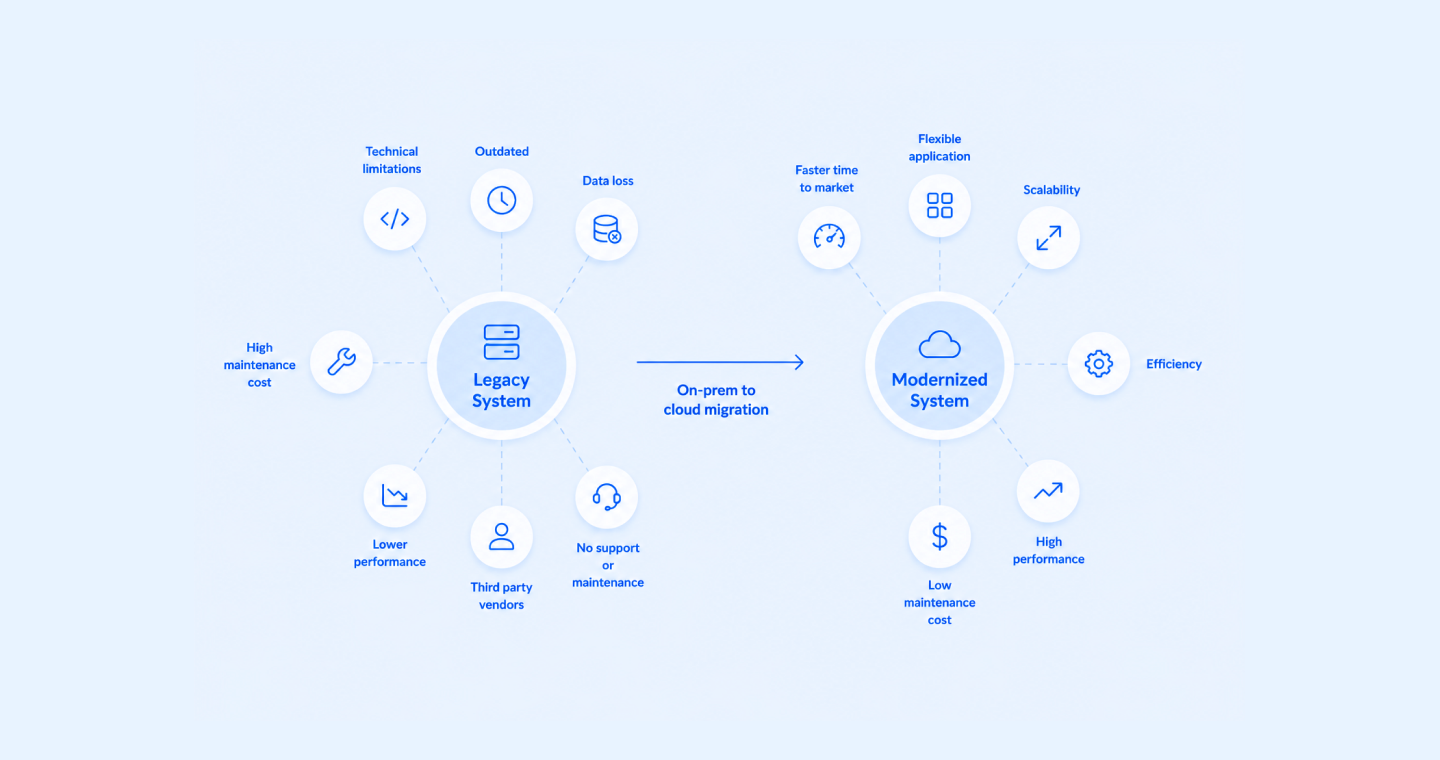
Legacy system modernization is the process of bringing an organization's existing systems, software, infrastructure, and architecture up to a standard that supports how the business actually operates today, not how it operated when the system was first built.
It isn't the same as replacing everything. Most modernization work is closer to renovation than demolition: keeping what still works, rebuilding what doesn't, and connecting old and new so the business never has to stop running while the work happens. What makes this hard usually isn't the technology itself, it's that legacy systems accumulate years of undocumented decisions and workarounds nobody wrote down, which makes touching any one part riskier than it should be.
AI hasn't changed why modernization matters. It's changed how fast we can map a system and where the real risk now sits.
Why Legacy Modernization Matters Now
Most businesses still run their most important work like billing, customer records, compliance, and logistics on software older than half the people maintaining it. That software wasn't built to talk to modern tools, and every year it stays untouched, the gap between what the business needs and what the system can do gets a little wider.
The real cost of a legacy system was never really the code. It's everything the code prevents: features that take months instead of weeks, integrations that break unpredictably, and engineers who spend more time protecting old logic than building anything new. Left alone, that gap compounds quietly, until a routine update turns into a multi-week fire drill.
There's also a shrinking pool of engineers who know the older languages many legacy systems still run on, which makes maintaining them more expensive every year, independent of anything AI can fix. Modernizing isn't just about capability anymore, it's about not staying dependent on a shrinking group of people who can safely touch the system at all.
The Real Challenges in Legacy Modernization
01. Data trapped in inconsistent formats.
Legacy systems often hold genuinely valuable data, scattered across formats that don't talk to each other cleanly. Moving that data into a modern platform without losing accuracy is often harder than the migration itself.
02. Technical debt that's accumulated for years.
Every shortcut taken under deadline pressure is still sitting in the codebase today, usually undocumented and written against frameworks nobody actively maintains. That debt compounds, it's a big part of why "simple" changes to old systems take so long.
03. A widening gap between old and new systems.
Legacy architecture and modern, cloud-native tools weren't designed to talk to each other. Bridging that gap carelessly is a common source of data loss, downtime, and integration failures.
04. Security and compliance debt.
Older systems were often built before today's security expectations existed, leaving real exposure to breaches and non-compliance. Closing that gap usually means retrofitting encryption, access controls, and monitoring into a system that was never designed with them in mind.
05. Cost and resourcing pressure.
Modernization takes real investment like new infrastructure, retraining, and often running two environments in parallel during the transition. Without a clear plan, that overlap gets expensive fast, which is why sequencing by business impact matters more than modernizing everything at once.
The Step-by-Step Guide
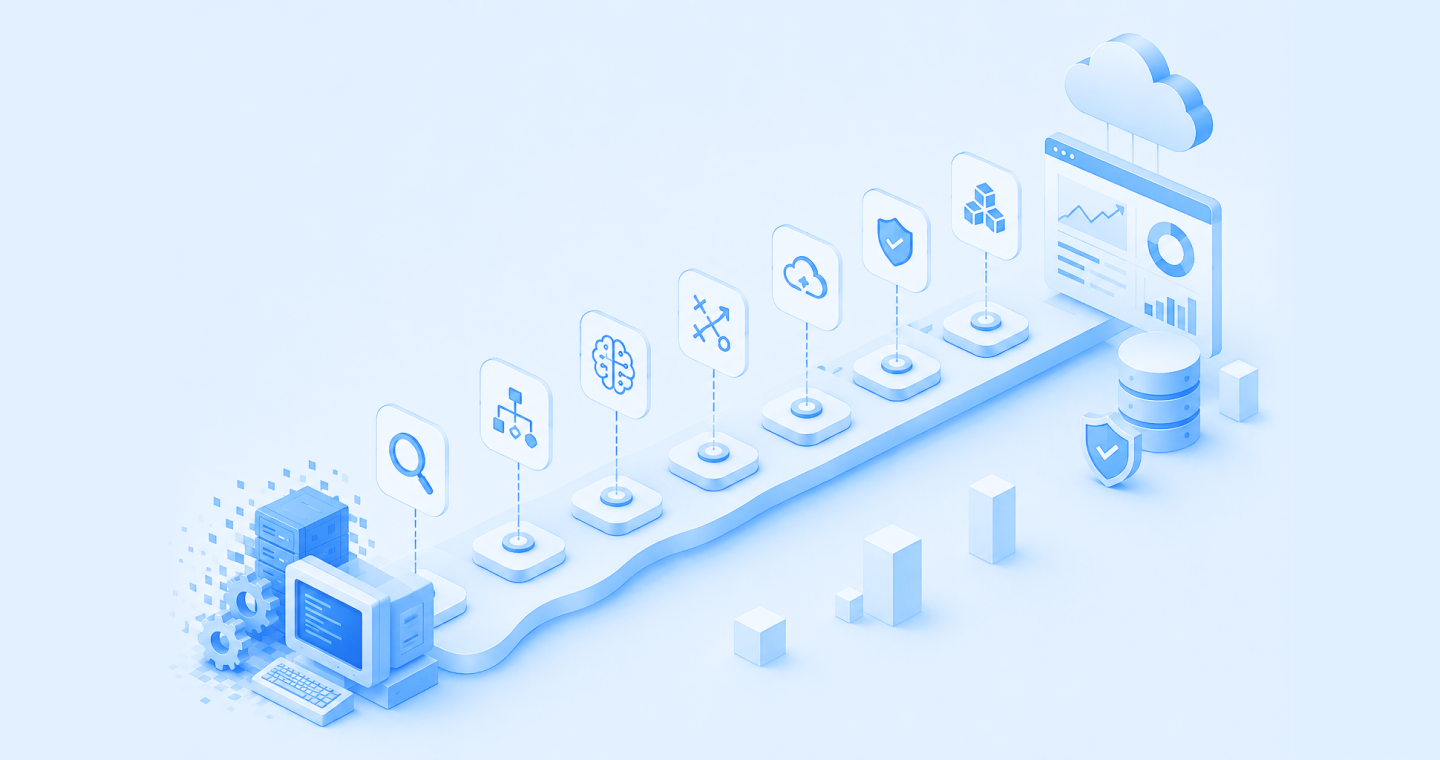
1. Understand the System Before You Touch It
The instinct with any AI modernization pitch is to point the model at the codebase and let it start working. Resist it. Before AI touches anything, someone needs a clear picture of what's running: what depends on what, what's regulated, what drives revenue, and what nobody on the current team has fully understood in years. Skip that step, and you haven't saved time, you've moved the confusion downstream, into production, where it costs far more to untangle.
2. Choose a Strategy for Each System, Not One for Everything
Not every legacy system needs the same treatment. Sorting systems into a few clear categories helps decide how to approach each one:
- Retain: some systems work fine and don't need to be touched yet.
- Retire: some are redundant, and shutting them down is the fastest win available.
- Replatform: move to modern infrastructure while swapping out the specific pieces holding it back.
- Refactor: break a rigid, monolithic system into smaller services, usually where AI has the most room to help.
- Replace: reserved for systems whose foundations are genuinely broken or whose logic no longer matches how the business operates.
This stops a project from defaulting to "rewrite everything," usually the riskiest option, not the cleanest one. Big-bang rewrites stretch on for years with no clear milestones, and by the time something ships, confidence in the whole effort has quietly eroded.
3. Let AI Handle the Reading, Not the Deciding
This is where AI genuinely earns its place, not as an architect, but as a research assistant with an unusually fast reading speed. AI tools are good at tracing how parts of an old system connect, turning undocumented logic into plain-language explanations a person can review, and spotting duplicated rules across a codebase. Some tools can now pull surprisingly accurate documentation straight out of old, poorly commented code that used to take a specialist weeks. Lean on AI here, without asking it to make a single call about how your business should work.
None of this scales without usable data underneath it, organized and centralized rather than scattered across formats. AI output is only as reliable as the data it's reading from.
4. Wrap the Old System Before You Replace It
One of the lowest-risk ways to modernize is leaving the legacy system running underneath and building modern, AI-assisted experiences around it: better search, automation, a usable interface connected through APIs, rather than tearing out the core on day one. The business gets real improvement sooner, without staking the entire project on a rewrite going exactly to plan.
5. Move in Stages, Never All at Once
Good modernization happens in phases, not one enormous leap. A well-run migration is designed so the business notices real improvement early, not after a year and a half of silence while everything gets rebuilt behind closed doors. Smaller stages also mean fewer surprises: each one gets tested before the next begins. This is also the stage for infrastructure decisions: moving workloads to the cloud, breaking monoliths into services, using containers so deployments stay consistent, handled deliberately, one stage at a time.
6. Review AI-Written Code Like You Would a New Hire's
This is the step most "AI-accelerated" projects skip, and it's the one that causes the most damage later. Code written by AI isn't automatically safe code left unreviewed, it can quietly introduce security gaps, especially when nobody gave the model clear instructions about handling sensitive data. The fix isn't avoiding AI-assisted coding. It's making sure nothing AI writes reaches production without the same scrutiny you'd give a new engineer's first weeks of work and building compliance requirements into the migration itself, not bolting them on after.
7. Modernization Doesn't End at Go-Live
Launching the new system is the start of a different phase, not the finish line. Modernized systems still need ongoing monitoring, performance tuning, and, if AI models are part of the new architecture, regular reviews to confirm they're still behaving as designed as real-world data shifts beneath them. Treat modernization as a project with an end date, and the system quietly drifts back toward "legacy" within a few years, just with newer code.
Modernization in Action: Three Real Examples
- Banking: HSBC. HSBC partnered with Google Cloud to modernize its transaction monitoring for money laundering, layering an AI-driven risk model on top of its existing compliance infrastructure rather than replacing it. The bank reported detecting two to four times more genuine suspicious activity while cutting false alerts by over 60%, freeing investigators to focus on real risk.
- Manufacturing: General Motors. At GM's Arlington Assembly plant, unplanned equipment failures were cutting into throughput on a line building well over a thousand vehicles a day. Rather than replace existing plant systems outright, GM layered AI-driven predictive maintenance on top of them, catching signs of failure before they became costly downtime.
- Retail: Walmart and Target. Both retailers modernized demand forecasting that used to run on far more rigid logic. Walmart's models now weigh hundreds of shifting variables like weather, local events, and seasonal trends to keep stock closer to actual demand at the store level. Target has taken a similar path through its Enterprise Acceleration Office, an internal program built around modernizing outdated systems and improving forecasting accuracy.
None of the three treated modernization as an all-or-nothing rewrite. Each identified the highest-impact system, layered AI carefully around what already worked, and expanded from there.
Where AI-Led Modernization Is Headed
01. Automation is expanding beyond the obvious.
The bigger shift isn't repetitive task automation, it's how much of the "boring middle" of modernization- documentation and dependency mapping- is becoming a first pass AI handles rather than a manual slog.
02. Interfaces are getting smarter without a backend rebuild.
Chat interfaces and smarter dashboards can now sit on top of legacy systems without the underlying system changing at all.
03. Retrieval-based AI is reducing the need to migrate data just to use it.
AI systems can pull directly from legacy databases in real time, rather than requiring every dataset to be physically moved first.
04. Agentic AI is starting to manage parts of the workflow itself. More capable AI systems are beginning to handle multi-step processes with less direct oversight, which raises the stakes on the review practices in Step 6 rather than lowering them.
What Working With UPDOT Actually Looks Like
We approach modernization the same way we approach every engineering project: AI accelerates the work, humans own the decisions. Our DevOps & Cloud team builds the infrastructure modernization depends on, our Software Engineering team handles discovery, migration, and testing, and our Maintenance & Upgrades team stays on after go-live, because modernization that ends at launch is a temporary fix with a longer runway.
We use AI to compress the slow, repetitive parts of the process: understanding old systems, writing documentation, generating test coverage. We don't use it to make architectural calls or skip security review. Full IP is transferred to you at the close of every project, and we're still around when the modernized system needs to evolve again.
See how our engineering teams work together on modernization projects.
Frequently Asked Questions
Using AI tools to speed up the slow, manual parts of modernizing old software: understanding what a system does, mapping how it's connected, writing tests, translating code while people stay in charge of decisions like architecture and security.
Replacement means starting over. Modernization means keeping what works and connecting old with new, which is why frameworks like retain, retire, replatform, refactor, and replace exist: to match the right approach to each system instead of defaulting to a full rebuild.
It depends on the system's size and complexity, but a well-run migration shows real progress in the first few months, not near the end of one long, single-phase project.
Not by default. It needs the same review, testing, and security checks as any other code before reaching production, arguably more, since it's easy to assume AI-written code is already correct.
A full rewrite makes sense when a system's foundations are genuinely broken. In most other cases, wrapping it with modern, AI-assisted interfaces the same pattern HSBC and GM both used, gets real value faster and with far less risk.
Conclusion
Legacy system modernization with AI works when AI is treated as leverage inside a disciplined process, not a replacement for the process itself. The organizations getting real value, like HSBC, GM, Walmart, Target, and plenty of companies smaller than all four, pair AI-assisted discovery, staged migration, and careful security review with human judgment at every decision point. The ones getting burned skipped straight to automation and found out what they'd missed once it was already in production.
Ask who reviews the AI-generated code before it ships. Ask for a plan that shows progress in months, not a single date eighteen months out. And pay attention to whether anyone can explain the "why" behind the architecture, not just the "how."
When you're ready to have a straight conversation about modernizing what you've already built, talk to UPDOT. No pitch deck. Just an honest answer.